
Charlotte Independence Coach Mike Jeffries From New York Cosmos Draft Pick in the NASL to USL League One Finals

Charlotte Independence Coach has lived a full soccer life playing and coaching in every US Soccer League-NASL-MISL-MLS-USL
November 9, 2026 By Jim Whelan and Jerry Cala from Cosmos Country Podcast

In December 1983, the New York Cosmos used the third overall pick of the NASL draft on a Duke sweeper named Mike Jeffries. Forty-three years later, he is one win from a USL League One title with the Charlotte Independence, in a season that started with a loss to the Cosmos.
Jeffries never played a minute for New York. The league he was drafted into was dead within a year. But the thread that runs from that draft-day phone call to Saturday’s final is one of the longest in American soccer, and it keeps looping back to the club in green and white.
The NASL that drafted Jeffries came out of a single broadcast. On July 30, 1966, NBC carried the World Cup final, England’s 4–2 extra-time win over West Germany at Wembley. It was sent by satellite from the BBC on a slight tape delay, and it was the first time a World Cup final had been shown to a national American audience.
The ratings got the attention of American sports owners. Clive Toye, later the Cosmos’ general manager, called NBC’s broadcast the final push toward a modern pro league. Investors had been circling before the final, but the telecast gave them momentum.
In 1967 two rival leagues launched at once. The National Professional Soccer League had a CBS television deal but no federation sanction. The United Soccer Association had official approval but imported entire foreign clubs and gave them American names. Both lost money, and on December 7, 1967, they merged into the North American Soccer League.
The new league struggled for years before the Cosmos changed everything by signing Pelé in 1975. By the time Jeffries was drafted in 1983, though, over-expansion, recession and labor fights had it running on fumes. He was joining the last chapter of a story that began with one afternoon on NBC.
How the Cosmos got the No. 3 pick

The pick wasn’t originally New York’s. It belonged to the Fort Lauderdale Strikers. On December 13, 1982, the Cosmos sent midfielder Steve Wegerle to the Strikers. In return they got Fort Lauderdale’s 1983 first-rounder, its 1984 first-rounder, and cash.
A year later that 1984 pick came in at No. 3, and the Cosmos spent it on Jeffries. He arrived with a big résumé. He had won the 1983 Hermann Trophy as college soccer’s national player of the year, and he had been in the 1982 NCAA final that Duke lost to Indiana in the eighth overtime period.
The draft itself was a knot of trades. Tampa Bay took Roy Wegerle, Steve’s brother, first overall. The Strikers, who had moved to Minnesota just weeks earlier, flipped a second-rounder on draft day to move up to No. 5.
The Cosmos held three of the first ten picks, and Jeffries was the first name they called. The NASL’s glamour club of Pelé and Beckenbauer made him their top choice in what turned out to be the league’s last draft.
Minnesota, not Manhattan

Jeffries never suited up for the Cosmos. Months before the NASL draft, the Strikers had made him the first pick of the 1983 Major Indoor Soccer League draft, and the first American taken. In 1984 he played for the Minnesota Strikers, the same franchise whose pick the Cosmos had used to take him. It is not clear from the record how his rights were settled. He made 8 NASL appearances and scored 1 goal.
The NASL folded after that season. The Strikers moved indoors to the MISL, and Jeffries stayed from 1984 to 1987. He then spent a season with the Dallas Sidekicks before a torn ACL ended his career. Along the way he earned 3 caps for the U.S. men’s national team.
On his first day in Minnesota, the first teammate he met was Gregg Thompson. Thompson had scored the goal that beat Jeffries’ Duke side in that 1982 final, and Jeffries told U.S. Soccer he got reminded of it right away.
For a while after that, soccer let him go. He took a job as a stockbroker at Smith Barney and planned on business school. He needed a paycheck, so he started coaching, and he hasn’t stopped since.
When the game went indoors to survive
When the NASL folded after 1984, the United States had no national outdoor league for more than a decade. For a time the Major Indoor Soccer League was the top level of professional soccer in the country. From 1985 to 1992, the highest rung of the pro ladder was played on turf laid over hockey rinks.
Indoor soccer was fast, high-scoring and built for arenas, and purists hated it. But it drew crowds. Over its 14 seasons the MISL averaged 7,644 fans per regular-season game, with bigger crowds in the playoffs. Clubs like the Baltimore Blast, San Diego Sockers and Dallas Sidekicks became local institutions.
Most important, it kept players, coaches and fans in the sport. When the NASL died, its players flooded into the MISL, the only full-time pro league left. Without that paycheck, many would have walked away. It filled the gap until the U.S. hosted the 1994 World Cup and Major League Soccer kicked off in 1996.
Jeffries lived that bridge. He was the first American taken in the 1983 MISL draft, and he played 4 indoor seasons with the Strikers and Sidekicks. He was one of the players indoor soccer kept in the game, and later, after MLS arrived, he coached in the league that took over from it.
Three decades on the sideline
His coaching career began in the lower leagues. He took over the New Orleans Riverboat Gamblers, first as an assistant in 1993 and then as head coach from 1995. In 1998 he joined Bob Bradley’s staff at the expansion Chicago Fire. Chicago won MLS Cup and the U.S. Open Cup in its first season, and Jeffries won a second Open Cup there in 2000.
In 2001 he got his first MLS head-coaching job with the Dallas Burn, now FC Dallas. He reached the playoffs in 2001 and 2002 and was a Coach of the Year nominee in 2002. A 4–16–4 season in 2003 cost him the job.
After Dallas he went back to college soccer, including a stint as associate head coach at his alma mater, Duke. He also coached the amateur Des Moines Menace, who knocked off a professional Minnesota United side in the Open Cup. He scouted for the U.S. national team at the 2010 World Cup.
Charlotte, and a season that began at the Cosmos

The Independence hired Jeffries as their first head coach on December 5, 2014. Twelve seasons later he is still there, now as head coach and general manager. That longevity is rare in lower-division American soccer. In 2015, their first year, the club beat MLS side New England on the way to the Open Cup Round of 16. In 2023 they reached the League One final, where they lost on penalties to North Carolina FC. In 2025 they fell to One Knoxville in the quarterfinals.
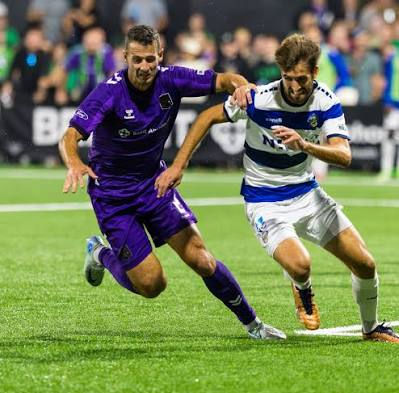
The 2026 season opened with a twist. The revived New York Cosmos joined USL League One, and on April 3 they beat Charlotte 3–2 at Hinchliffe Stadium in Paterson, New Jersey. It was the Independence’s first league loss of the year. The club that once drafted Jeffries had handed his team its first defeat.
After that, Charlotte took off.
An 8-game winning streak from May 6 to July 1, the longest in the league this season, including a 2–0 win over first-place Union Omaha.
June honors for Jeffries as USL League One Coach of the Month, with Luis Alvarez as Player of the Month.
The Players’ Shield, the club’s first, with a 20–6–6 record and 66 points. 74 goals, a league single-season record, led by Golden Boot winner Souaibou Marou with 18.
In the playoff quarterfinal on November 1, No. 1 Charlotte routed No. 8 FC Naples 5–1. Christian Jaime had a goal and two assists, and Stéfano Pinho scored twice off the bench, without Marou or Golden Playmaker Jon Bakero contributing (USL League One).
On November 8 they beat Forward Madison 2–1 in the semifinal. Charlotte scored early, and Madison answered almost right away. Then in the 40th minute defender Séga Coulibaly scored his first goal for the club, and it held up as the winner. Golden Playmaker Jon Bakero had a hand in both goals, and goalkeeper Matt Levy made six saves as Charlotte held on through seven minutes of stoppage time.
That sets up a home final. On Saturday, November 14, at 7:30 p.m., the Independence host Athletic Club Boise at the Mecklenburg County Sportsplex in Matthews. Boise reached the final in its first season, on Jesús Barea’s 114th-minute winner against Chattanooga. The last two Players’ Shield winners both went on to win the final, and Charlotte is trying to make it three in a row.
From the Cosmos’ draft board to a trophy
The 1984 draft was supposed to start Jeffries’ career with the most famous club in America. Instead, the league collapsed around him, his knee gave out, and he rebuilt a life in the game one rung at a time. That climb took him through the USISL, MLS, college soccer, the PDL and the third division.
Now 64, he is one win from his first league championship as a head coach, and he gets to play for it at home. If Charlotte beat Boise on Saturday, a career that began as the Cosmos’ No. 3 pick would reach its peak in the same league the Cosmos rejoined this year. The last time these Independence players lost to the Cosmos, it was April and they hadn’t yet found their stride. Since then they have been the best team in League One.
Jeffries has seen American soccer fall apart and come back. Saturday night in Matthews, he gets 90 minutes to finish the story his draft day started.
Jim Whelan and Jerry Cala cover the New York Cosmos and USL League One in a weekly podcast Cosmos Country.

Comments